
Knife Gate Valves Browse All 


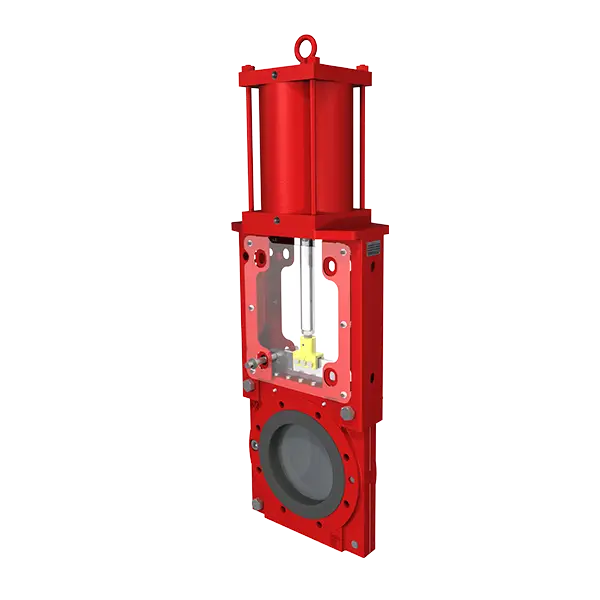


Select a featured product type to jump to that section.
Unidirectional
Bidirectional
Urethane Lined
O-Port
Push-Through, Slurry Valves
Guided Shear Gate
Zero Pocket
Select a featured product type to jump to that section.
Select a featured product type to jump to that section.


Select a featured product type to jump to that section.
Select a featured product type to jump to that section.


1 Various Actuation Options
2 Grease Fitting
3 Direct Mounting
4 Proximity Sensors


5 Safety Covers
6 High Visibility Clevis
7 Lockout Pin
8 Transverse Seal Design


9 Low Friction Gate Glides
10 Replaceable Wear Rings
11 Xylan Coated WCB Body
12 Xylan coated 17-4 PH Gate


13 Round Port Design
14 Positive Gate Stop
15 Secondary Metal Seat
16 Bidirectional Sealing
17 Atmospheric Seal

Handwheel
Handwheels are the standard operator for all knife gate valves and provide manual operation by rotating a drive nut to extend and retract the stem, which is connected to the gate with a clevis. They offer simple, dependable operation for rugged service environments.

Non-Rising Stem
A non-rising stem design is advantageous in applications with low headroom. By rotating the stem itself instead of a drive nut, the stem remains within the yoke and does not extend upwards when opening the valve. The disadvantage is that the opening/closing forces are not inline with the gate and can lead to premature wear of some components as well as increased thrust requirements.

Gear Box
Bevel gearboxes are used to manually operate large or high-torque linear valves, such as knife gate valves, with reduced input effort. They allow precise valve operation with minimal manual force allowing smooth, controlled operation even under demanding pressure conditions.

Chainwheel
Chainwheels are used to manually operate overhead or hard-to-reach valves by pulling a chain loop attached to the handwheel or gearbox. They allow valve operation from ground level, improving operator safety without the need for ladders or elevated platforms.

Pneumatic Cylinder
Pneumatic cylinders are used to actuate linear valves, such as knife gate valves, in demanding or repetitive process applications. General purpose cylinders provide reliable, consistent operation with minimal maintenance, and are typically used in the water industry and standard industrial processes.

Oversized Cylinder
An oversized cylinder (larger bore) may be utilized in applications where minimum required air pressure cannot be achieved or for applications requiring greater actuation force than normal.

Pneumatic Cylinder (Fail Close)
Fail Close pneumatic cylinders are used to actuate knife gate valves in critical slurry, wastewater, or process applications. By incorporating an internal spring, they automatically force the valve to close during an air loss event. This ensures safe, reliable valve actuation during air supply failures to protect personnel and equipment.

Pneumatic Cylinder (Fail Open)
Fail Open pneumatic cylinders are used to actuate knife gate valves in critical slurry, wastewater, or process applications. By incorporating an internal spring, they automatically force the valve to open during an air loss event. This ensures safe, reliable valve actuation during air supply failures to protect personnel and equipment.

Hydraulic Cylinder
Hydraulic cylinders are typically used to actuate large linear valves, such as knife gate valves, in high-pressure slurry or abrasive applications. Hydraulics provide a high force output from a relatively small size (compared to pneumatic cylinders) offering reliable operation and control in the toughest industrial environments.

Electric Actuator
Electric multi-turn actuators are used to operate knife gate valves in applications requiring precise, automated control or in remote environments where air or hydraulic supplies are unavailable. Electric actuation provides precise positioning, ease of integration with control systems, and lower maintenance.

Position Sensors
Position sensors utilize proximity probes and a magnetic target to detect the valve position and provide reliable feedback to a control system. Mounting directly to the yoke and detecting the position of the gate provides a more reliable solution than cylinder mounted switches. Hazardous area versions are available.

Solenoid Valve
Solenoid valves are used to control the opening and closing of a pneumatically actuated valve. A NAMUR style valve is typically used for rack pinion style actuators, and an inline valve is used for pneumatic cylinders. They are available with AC or DC coil voltages and with approvals for use in hazardous areas.

Filter/Regulator
A regulator controls the air pressure used to operate a pneumatically actuated valve. Combined with an air filter and auto-drain to remove any condensation in the line, it also provides protection of downstream pneumatic components and improves system reliability.

Chrome White Iron Wear Rings
Chrome white iron is a high chromium cast iron alloy known for its exceptional wear resistance and hardness.
Not our Elite Valve Distributor?
Become A Distributor


